Lieutenant JG Theodor Wishmore
.png)
Name Theodor Thomas Wishmore
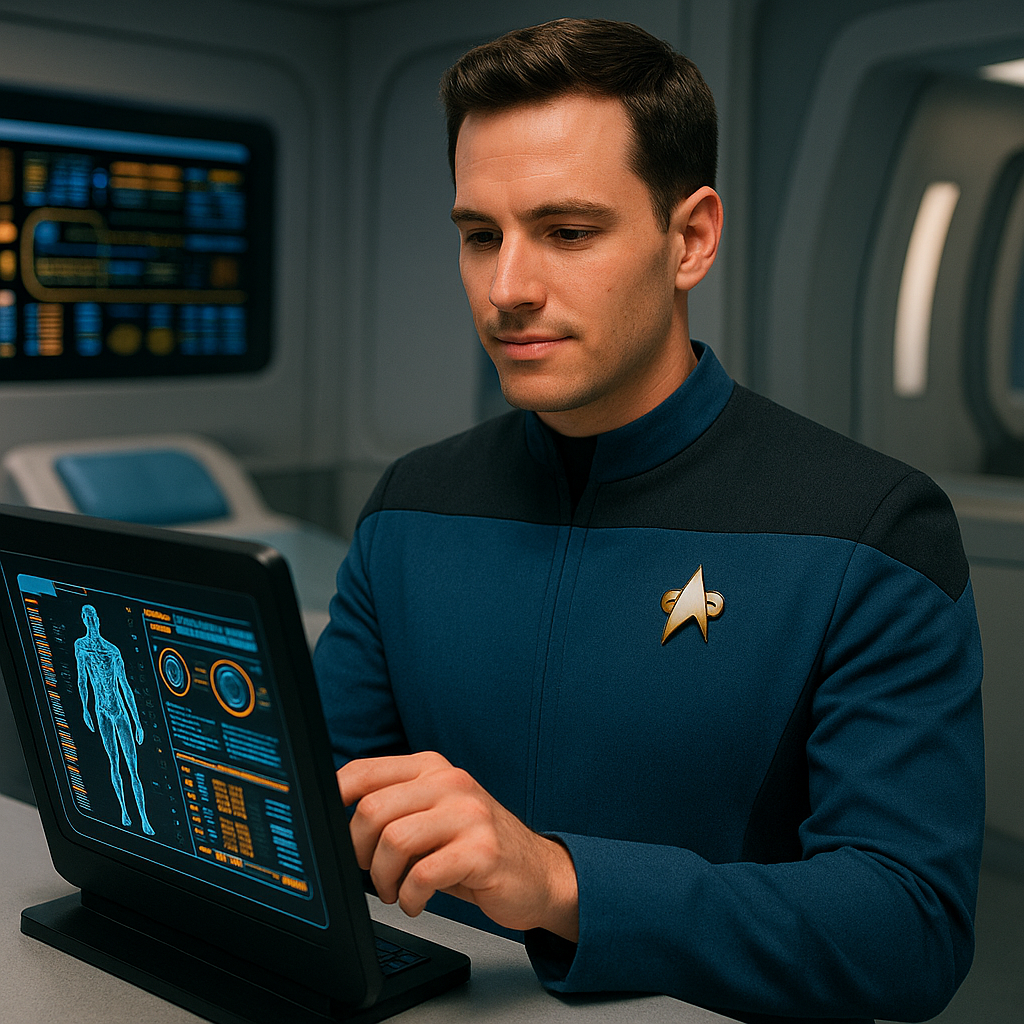
Position Assistant Chief Medical Officer
Rank Lieutenant JG
Stats
- 13 Mission Posts
Last Post
Wed Sep 16th, 2026 @ 10:07pm
Character Information
| Gender | Male | |
| Species | Human | |
| Birthplace | New Haven, Connecticut, Earth | |
| Age | 32 |
Physical Appearance
| Height | 6ft | |
| Weight | 77Kg | |
| Hair Color | Brown | |
| Eye Color | Brown | |
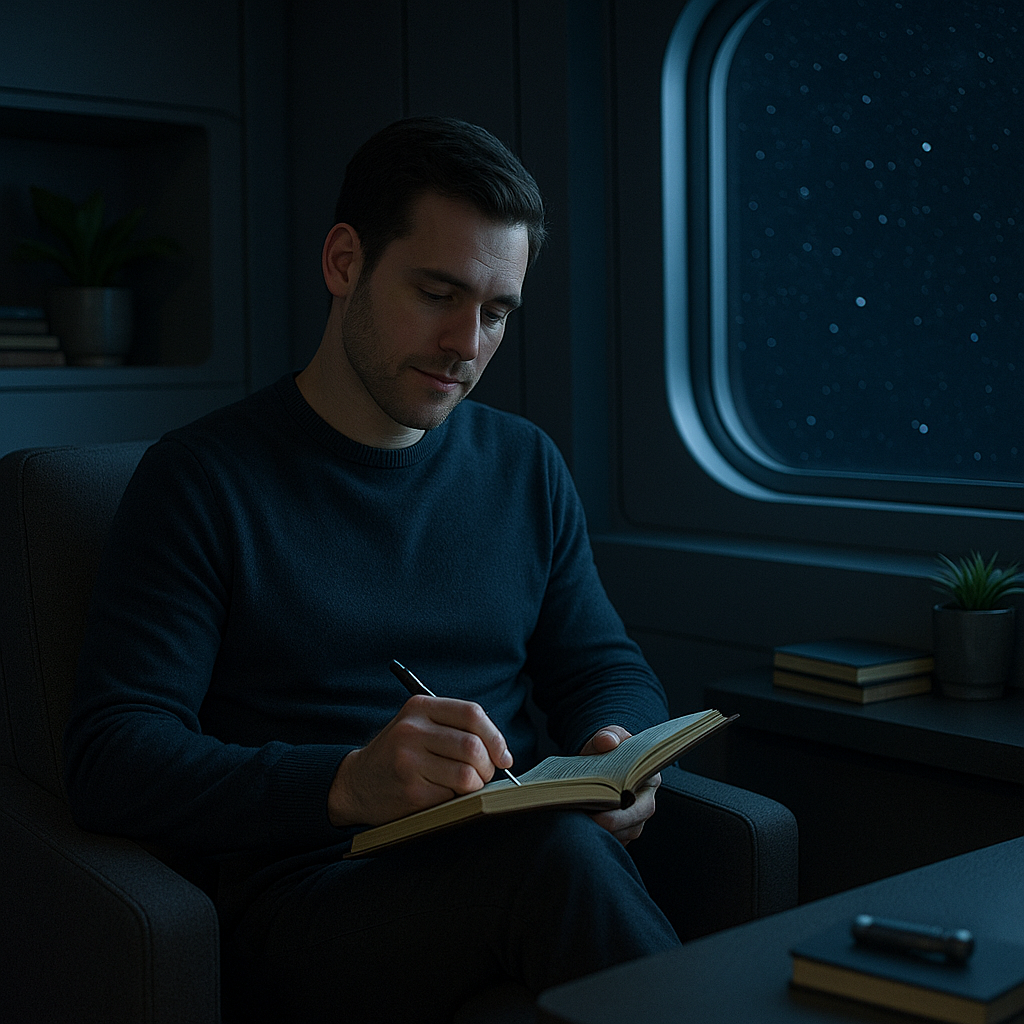
| Physical Description | Standing just over six feet tall, Theo possesses the lean, athletic build of someone who has spent years balancing long shifts with quiet discipline rather than pursuing strength for its own sake. Regular running, swimming, and cycling have given him the understated physique of an endurance athlete—fit without appearing imposing. He carries himself with an easy, unhurried confidence that often makes him seem calmer than the situations around him. His dark brown hair is kept neatly trimmed, his warm brown eyes are observant without ever feeling clinical, and he is almost invariably clean-shaven. Years of habit have left him impeccably turned out; whether in uniform or civilian clothes, there is rarely a crease out of place or a detail overlooked. Colleagues occasionally joke that he looks as though he has stepped straight out of a Starfleet recruitment holovid, though those who know him understand the appearance is less vanity than quiet professionalism. Despite his polished appearance, there is little stiffness about him. Theo's expression is often softened by an easy smile or a thoughtful look of concentration, and patients frequently remark that he has an unusual ability to make a room feel calmer simply by walking into it. More often than not, the only visible sign that he has been working far too long is a forgotten mug of tea growing cold beside whatever medical text or journal has captured his attention. |
Family
| Father | Adm. Jonathan Alaric Wishmore, Ret. | |
| Mother | Dr Catherine Elise Wishmore | |
| Brother(s) | Capt. Marcus Jonathan Wishmore, Commanding Officer; USS Astute | |
| Sister(s) | Lt Cdr. Alexandra 'Lexa' Wishmore, Chief Ops Officer; USS Torbay | |
| Other Family | vAdm. Beatrice WIshmore (Ret.) Paternal Grandmother Cdr. Henry 'Hal' Wishmore, Paternal Uncle, (Deceased) Cadet. Isla Wishmore, Starfleet Academy, Niece |
Important Relationships
| Mentors | Dr Alana Tse Dr. Tse shaped Theo’s early field instincts, teaching him to balance rapid triage with compassion and ethics. Her calm authority during crises impressed upon him the value of composure and presence. From her, he learned that a physician’s steadiness is often as healing as their skill, and that empathy must never be sacrificed to efficiency. Dr Julian Varn Dr. Varn refined Theo’s understanding of leadership and pragmatism in medicine. Working under frontier conditions, he taught Theo to adapt without compromising ethics, to lead by calm example, and to prioritize people over procedure. Varn’s mentorship cemented Theo’s quiet confidence and his belief that integrity defines a healer more than accolades or perfection. |
Personality & Traits
| General Overview | Theodor is, by almost any measure, an exceptionally kind man. Years spent growing up beneath the quiet expectations of the Wishmore name taught him emotional discipline from an early age. Rather than suppressing his feelings, he learned to carry them privately, believing that his own burdens should never become someone else's. The result is a physician of remarkable composure; patients often find his calm presence reassuring, while colleagues quickly discover that very little unsettles him, even in the midst of crisis. Behind that steadiness lies a deeply reflective personality. Theo is naturally observant, preferring to listen before he speaks and rarely rushing to judgement. He possesses an understated, dry sense of humour that tends to emerge once he feels comfortable, along with an ability to make others feel heard without ever making himself the centre of attention. Although genuinely warm and approachable, he can initially appear guarded in unfamiliar company, instinctively steering conversations away from his own life with practiced grace rather than outright avoidance. Morally, Theo possesses a quiet certainty. He believes medicine is fundamentally an act of service and that compassion carries little value without discipline to support it. Once he reaches a conclusion, he defends it with calm conviction rather than forcefulness, favouring thoughtful discussion over confrontation. He is not a man prone to raising his voice, but neither is he easily moved from principles he believes to be right. For all his composure, Theo is often far more forgiving of others than he is of himself. He has a habit of quietly carrying responsibility long after others have set it down, and would much rather spend an evening helping a friend through their troubles than admitting he has any of his own. It is a contradiction that makes him an exceptional doctor—and, perhaps, a difficult patient. |
|
| Strengths & Weaknesses | StrengthsTheo possesses an unusually analytical mind, preferring observation, hypothesis, and careful verification over instinctive conclusions. Methodical without being inflexible, he is adept at recognising patterns others overlook and rarely allows urgency to compromise accuracy. In medicine, this makes him an exceptional diagnostician; in a crisis, it allows him to remain thoughtful when others begin reacting. Years spent in emergency medicine have cultivated an extraordinary calm under pressure. Theo does not become louder or faster as situations deteriorate—he becomes quieter. His composure has a reassuring effect on those around him, allowing patients and colleagues alike to borrow his confidence until they find their own. It is a quality that has become one of his defining characteristics. Blessed with an exceptional memory, Theo retains an astonishing breadth of medical knowledge, recalling obscure case studies, xenobiological anomalies, and Federation medical precedent with remarkable ease. Yet he wears that knowledge lightly, rarely presenting it as expertise to be admired, but simply another tool to help the patient in front of him. Perhaps his greatest strength, however, lies in his ability to make people feel seen. Theo listens with genuine attention, notices small changes in behaviour that others miss, and instinctively understands that reassurance can be as therapeutic as medication. To him, medicine begins long before the tricorder leaves its holster. WeaknessesTheo's greatest critic has always been himself. Growing up within the long shadow of the Wishmore family legacy instilled standards that are, by any reasonable measure, impossible to meet. Success is accepted quietly; mistakes linger. Even minor failures can become the subject of prolonged self-reflection, and he has a habit of quietly assuming responsibility long after others have moved on. His instinct to care for others often comes at his own expense. Theo finds it far easier to shoulder another person's burden than admit to carrying one himself, routinely working beyond reasonable limits before considering rest or asking for help. It is a habit born less from pride than from an ingrained belief that he should never become someone else's concern. Although naturally warm, Theo remains deeply private. He forms friendships slowly and speaks little of his own struggles, often redirecting conversations with gentle humour or thoughtful questions rather than discussing himself. Those closest to him know this reserve conceals considerable emotional depth, but earning that level of trust takes time. Despite an increasingly distinguished career, Theo quietly wrestles with impostor syndrome. He cannot entirely silence the suspicion that his surname may have opened doors that his abilities alone might not have. Ironically, this doubt drives him to work harder than almost anyone around him, continually trying to prove—to himself more than anyone else—that he has earned every opportunity afforded to him. |
|
| Ambitions | Professionally, Theo hopes to leave medicine better than he found it. Whether through clinical research, medical ethics, or the treatment of diseases that have resisted generations of physicians, he aspires to make a contribution that will outlast his own career. The prospect of one day helping solve one of the Federation's enduring medical mysteries remains one of his greatest professional motivations. On a more personal level, he hopes to build a legacy that belongs to him. Theo has never wished to escape the Wishmore name, only to add something meaningful to it. Rather than being remembered simply as the son of Admiral Jonathan Wishmore, he hopes that future generations will think of him as a physician whose compassion became as much a part of the family's legacy as its long tradition of service. Perhaps most importantly, Theo hopes to learn that a meaningful life is measured by more than duty alone. Years devoted to study, service, and responsibility have left little room for himself. He quietly dreams of lasting friendships, a family of his own, and a home filled with the same warmth his mother created throughout his childhood. Though he rarely speaks of it aloud, he hopes that one day his greatest achievements will not be found in Starfleet records, but around a dinner table shared with the people he loves. |
|
| Hobbies & Interests | Away from Sickbay, Theo naturally gravitates toward quieter pursuits. He remains an avid reader, though as often as not his evenings end with pen in hand rather than a padd. He keeps a growing collection of leather-bound journals, begun during his years at Starfleet Medical, using them to record observations, reflections, sketches, and the occasional letter he never intends to send. Writing longhand has become a ritual that helps him slow his thoughts in a way modern technology never quite can. Music has been a constant throughout his life. Taught piano and cello by his mother during childhood, he later taught himself guitar while at the Academy as a more personal form of expression. His tastes range from Earth classical composers to quieter orchestral works from across the Federation, and he often plays simply to think. Although an accomplished musician, Theo is surprisingly self-conscious about performing for others, preferring music as something shared only with those he trusts deeply. Medicine remains both profession and hobby. He has developed an almost curator's fascination with historical medical equipment and maintains a small collection of field medkits spanning Starfleet history, from the NX Program through the Dominion War and into the modern era. To Theo, each represents not only technological progress but the generations of physicians who carried them into the unknown. When he needs to clear his mind, Theo gravitates toward solitary exercise. Running, swimming, cycling, and long walks provide an opportunity to untangle problems without consciously trying to solve them. He enjoys cooking when time allows—more enthusiastic than accomplished, by his own admission—and quietly takes pride in learning recipes from different cultures encountered throughout Starfleet. Friends have also discovered that offering someone food is one of Theo's instinctive ways of showing he cares, whether through a home-cooked meal, a fresh pot of tea, or a carefully chosen pastry. |
History
| Personal History | Born in New Haven, Connecticut, Theodor Thomas Wishmore grew up surrounded by a legacy that stretched back to the earliest days of Starfleet. The Wishmore family had served the Federation since the NX era, and service was woven into the rhythm of everyday life rather than spoken of as an obligation. His father, Admiral Jonathan A. Wishmore, was renowned for his strategic brilliance and unwavering discipline, while his mother, Dr. Catherine Elise Montrose Wishmore, served as Chair of the Federation Board of Medical Ethics and became Theo's greatest influence, instilling in him the belief that compassion and competence should never exist separately. As the middle of three siblings, Theo naturally occupied quieter ground. His elder brother Marcus seemed born for command, while his younger sister Alexandra possessed an engineer's restless curiosity and sharp wit. Theo instead developed an instinct for observation, spending more time asking questions than seeking attention. Music became a private refuge under his mother's guidance, while medicine gradually revealed itself not simply as a profession, but as a way of understanding people. Rather than entering Starfleet immediately after preparatory school, Theo chose a less conventional path by attending Yale University. Much to Jonathan's frustration—and Catherine's quiet approval—he immersed himself in xenobiology and comparative anatomy, graduating with distinction in 2390 and earning the Mariner Medal for Undergraduate Research. His thesis, examining xenoneural pathways and the evolution of pain responses across non-Terran species, reflected a fascination that would remain central throughout his career: not simply how alien biology functioned, but how different species experienced suffering. Admission to Starfleet Medical inevitably brought comparisons to the Wishmore name, but they proved short-lived. Graduating with honours in Xenopathology and Trauma Medicine in 2394, Theo earned recognition for calm judgement, meticulous diagnostic reasoning, and an unwavering commitment to medical ethics. His essay The Physician's Duty Beyond Species Boundaries received the Federation Medical Ethics Prize, while clinical rotations at Starfleet Medical, the Mars Rehabilitation Facility and Utopia Planitia exposed him to everything from catastrophic trauma to long-term rehabilitation. His early career quickly reinforced that reputation. Beginning in Starfleet Medical's Emergency Response and Disaster Relief Division, Theo assisted in large-scale triage following the Coridanite mining colony collapse before transferring to the USS T'Paal, where two years of scientific and diplomatic exploration broadened both his medical expertise and his appreciation for cultural nuance. There he co-authored research into Trinexian blood crystallization disorder, establishing himself as both a capable clinician and an emerging researcher. Promotion to Starfleet Medical Outpost 47—known informally as The Spindle—placed him in one of the Federation's busiest trauma centres. Serving as Chief Trauma Resident, Theo supervised junior medical officers while responding to a steady stream of emergencies across the Regulus Sector. It was during this assignment, under the mentorship of Dr. Julian Varn, that his approach to medicine truly crystallized. Varn's insistence that "the patient arrives before the protocol" became a philosophy Theo quietly carried into every future posting. His appointment as Acting Assistant Chief Medical Officer aboard the USS Kobayashi during a prolonged epidemic response further demonstrated an unusual steadiness under pressure. Colleagues noted his ability to remain composed during prolonged crises, his willingness to shoulder difficult decisions without seeking recognition, and his habit of treating reassurance as an essential part of medicine rather than an optional courtesy. His performance earned a commendation for Meritorious Service and a recommendation for permanent senior medical responsibilities. In 2400, Theo accepted transfer to the USS Sojourner as Assistant Chief Medical Officer. Though still early in his career, he arrived with a growing reputation as a physician whose greatest strength lay not only in diagnosis or surgery, but in his ability to bring calm to the people around him. Whether facing a mass-casualty incident, an unfamiliar species, or a frightened patient, Theo approaches each with the same quiet conviction: medicine begins by understanding the person in front of you. |
Service Record
| Service Record | Education Yale University, Earth — B.Sc. Xenobiology & Comparative Anatomy, Class of 2390 • Graduated with Distinction; awarded the Mariner Medal for Undergraduate Research in Comparative Anatomy • Thesis: “Xenoneural Pathways and the Evolution of Pain Response in Non-Terran Species” Starfleet Medical Academy, San Francisco, Earth — Doctorate in Xenopathology & Trauma Medicine, Class of 2394 • Graduated with honors • Recipient, Federation Medical Ethics Essay Prize (“The Physician’s Duty Beyond Species Boundaries”) • Clinical rotations: Starfleet Medical San Francisco, Mars Rehabilitation Facility, and the Utopia Planitia Trauma Unit Starfleet Postings 2394–2395 – Ensign - Junior Medical Officer, Starfleet Medical, Earth • Assigned to the Emergency Response & Disaster Relief division under Dr. Alana Tse. • Assisted in triage operations following the Coridanite mining colony collapse (2395). • Commendation for Exemplary Conduct under Field Conditions. 2395–2397 – Ensign - Medical Officer, USS T’Paal (Nebula-class) • Posted to the T’Paal during a 2-year diplomatic and scientific survey of the Trinexis sector. • Co-authored a Starfleet Medical Journal paper on Trinexian blood crystallization disorder, earning departmental citation. • Developed reputation for composure in crisis and precise diagnostic technique. 2397–2399 – Lieutenant (Junior Grade) - Chief Trauma Resident, Starfleet Medical Outpost 47 (“The Spindle”), Regulus Sector • Oversaw emergency medicine and xenopathology rotations for junior officers. • Commendation for Leadership in Crisis Response after a transport accident involving over 200 casualties. • Mentored by Dr. Julian Varn, whose pragmatic, patient-first philosophy would deeply influence Theo’s later bedside manner. 2399–2400 – Lieutenant (Junior Grade) Assistant Chief Medical Officer (Acting), USS Kobayashi (Steamrunner-class) • Filled in during extended mission in the Romulan border regions. • Noted for professionalism and emotional steadiness during a protracted epidemic outbreak on Starbase 412. • Commendation for Meritorious Service and recommendation for permanent Assistant Chief role. 2400-Present - Lieutenant (Junior Grade) Assistant Chief Medical Officer, USS Sojourner (Rhode Island-class) • |